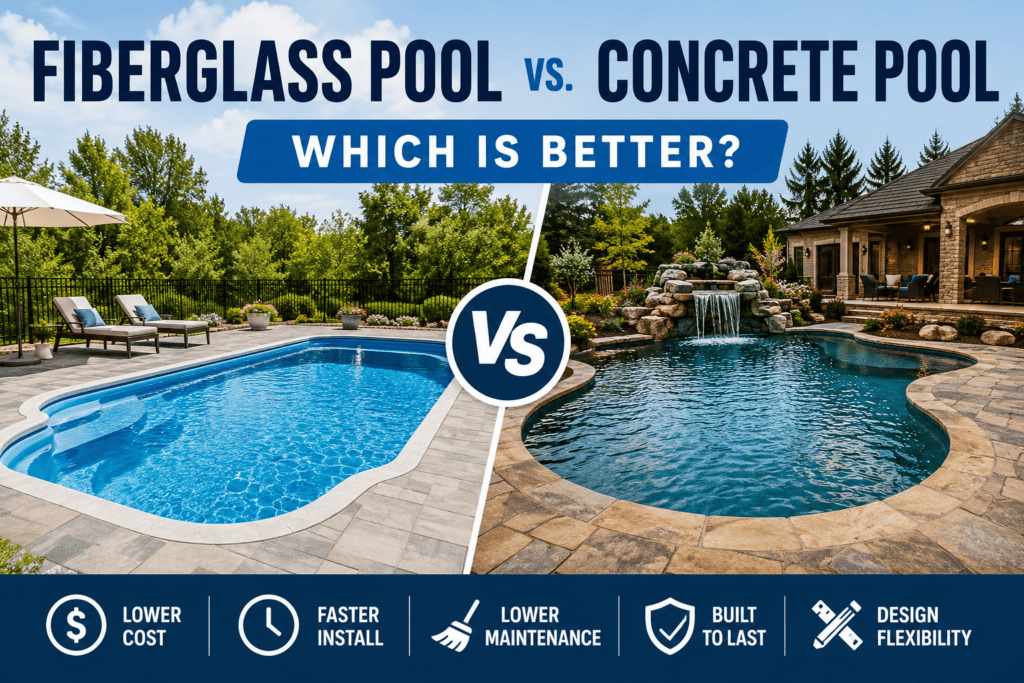
Fiberglass Pool vs. Concrete Pool: Quick Answer
If you’re deciding between a fiberglass pool and a concrete pool, here’s the short answer.
For most homeowners, fiberglass pools offer the best combination of affordability, durability, lower maintenance, and long-term value. Concrete pools provide nearly unlimited design flexibility, but they typically cost more to build, require more maintenance, and take significantly longer to install.
That doesn’t mean concrete pools are a bad investment.
If you’re building a luxury backyard with a completely custom design or unique architectural features, concrete may be the right choice. However, for the vast majority of homeowners, fiberglass provides everything they’re looking for while being easier to own and more affordable to maintain.
In this guide, we’ll compare fiberglass and concrete pools side by side so you can make an informed decision based on facts—not sales pitches.
Fiberglass vs. Concrete at a Glance
| Feature | Fiberglass Pool | Concrete Pool |
|---|---|---|
| Initial Cost | ✅ Lower | ❌ Higher |
| Installation Time | ✅ Faster | ❌ Slower |
| Maintenance | ✅ Lower | ❌ Higher |
| Algae Resistance | ✅ Excellent | ❌ Fair |
| Surface Comfort | ✅ Smooth | ❌ Rough |
| Design Flexibility | Good | ✅ Unlimited |
| Lifetime Ownership Cost | ✅ Lower | ❌ Higher |
| Longevity | ✅ 30+ Years | ✅ 30+ Years |
💡 Pool Professor: Both fiberglass and concrete pools can last for decades when they’re built correctly. The real question isn’t which one lasts longer—it’s which one you’ll still enjoy owning ten years from now.
What’s the Difference Between Fiberglass and Concrete Pools?
At first glance, every swimming pool looks about the same. Fill it with water, toss in a few floats, and nobody asks what it’s made of.
The real differences begin underneath the surface.
A fiberglass pool is manufactured in a controlled factory environment as one solid shell. Once it’s arrives at your home, the shell is carefully lowered into a prepared excavation, connected to the plumbing and equipment, and finished with decking and landscaping.
A concrete pool is built entirely on-site. Contractors excavate your backyard, install steel reinforcement, spray or pour concrete, complete the plumbing and electrical work, apply the interior finish, and allow everything to cure before the pool is ready for swimming.
Neither construction method is wrong.
They’re simply designed for different priorities.
Fiberglass focuses on efficiency, durability, and lower maintenance, while concrete focuses on complete design flexibility and customization.
Understanding those differences will help explain why installation time, maintenance, and long-term ownership costs vary so much between the two.
Installation Time
Let’s be honest.
Once you’ve decided to buy a swimming pool, waiting several months to enjoy it isn’t exactly part of the dream.
One of fiberglass’s biggest advantages is how quickly it can be installed.
Because the shell is already manufactured before it reaches your home, much of the work has already been completed. Once your backyard has been excavated and prepared, the shell is delivered, placed into the excavation, connected to the plumbing and equipment, and surrounded with your chosen decking.
Many fiberglass pool projects are completed within a few weeks, although weather, permits, and site conditions can affect the schedule.
Concrete pools require considerably more time.
Every stage of construction happens in your backyard—from excavation and steel reinforcement to concrete application, curing, interior finishing, and startup. It’s not uncommon for a concrete pool project to take several months before the first cannonball.
If your goal is to spend summer relaxing in your pool instead of watching construction equipment, installation time becomes an important factor.
🦀 Carl’s Complaint
Carl says:
“What’s another couple of months if I’m already spending this much money?”
💡 Pool Professor replies:
That’s easy to say in February.
Ask Carl again in July while he’s looking at a construction site instead of floating in his new pool.
Fiberglass Pool vs Concrete Pool Cost Comparison
Sooner or later, every homeowner asks the same question.
Which pool costs less?
For most homeowners, fiberglass pools offer a lower overall investment than concrete pools—not just on installation day, but throughout the life of the pool.
At Pool Shell Pros, fiberglass pool shells typically range from $11,500 to $32,000, while professionally installed projects generally fall between $35,000 and $50,000, depending on your property, site conditions, and optional upgrades.
Concrete pools generally start at a higher price because they’re built entirely on-site using more labor, more materials, and a significantly longer construction process. Add custom shapes, elaborate water features, premium finishes, or decorative masonry, and the investment continues to grow.
The purchase price, however, is only part of the story.
Long-term ownership costs often become the deciding factor, and that’s where fiberglass starts pulling ahead.
Lower maintenance, fewer chemicals, and no routine resurfacing can save homeowners thousands of dollars over the life of the pool.
Sometimes the smartest investment isn’t the cheapest one.
It’s the one that continues saving you money long after construction is finished.
Maintenance Requirements
Owning a swimming pool should mean spending more time swimming than scrubbing.
That’s one of the biggest reasons fiberglass has become the preferred choice for so many homeowners.
Fiberglass pools feature a smooth, non-porous gel coat finish that naturally resists algae growth. Because algae has a harder time attaching to the surface, you’ll typically spend less time brushing the walls, use fewer chemicals, and enjoy a pool that’s easier to maintain throughout the swimming season.
Concrete pools are different.
Their rough, porous surface gives algae plenty of places to grow, which often means more brushing, additional chemicals, and more routine maintenance to keep the water looking its best.
Neither pool is maintenance-free.
But if your idea of a relaxing Saturday involves floating with a cold drink instead of chasing algae around the deep end with a pool brush, fiberglass makes a pretty convincing argument.
🦀 Carl’s Complaint
Carl says:
“I don’t mind a little maintenance.”
💡 Pool Professor replies:
Neither do we.
The problem is “a little maintenance” has a funny way of becoming, “I’ll get to it next weekend.”
Durability
One of the biggest myths in the swimming pool industry is that concrete pools are automatically stronger because they’re made from concrete.
Durability isn’t just about hardness.
It’s about how a material performs over decades of use.
Fiberglass is incredibly strong while remaining slightly flexible. That flexibility allows the shell to adapt to normal ground movement without cracking under typical conditions. It’s one of the reasons fiberglass is used in boats, aircraft components, and countless other products designed to handle stress and movement.
Concrete is also extremely durable when it’s properly engineered and installed. However, because it’s rigid, significant ground movement can sometimes lead to cosmetic or structural cracks that require repair over time.
Both pool types are designed to last.
The difference is that fiberglass often gets there with fewer maintenance headaches—and fewer repair bills.
Customization
This is the one category where concrete earns a clear victory.
If your dream pool includes an infinity edge overlooking the mountains, a lazy river winding through your backyard, or a completely one-of-a-kind design, concrete offers virtually unlimited customization.
Fortunately, that’s not what most homeowners are looking for.
Most families want a beautiful pool that’s comfortable, durable, easy to maintain, and complements their backyard without requiring a second mortgage.
Today’s fiberglass pools are available in dozens of attractive shapes and sizes, complete with tanning ledges, built-in benches, integrated spas, and family-friendly layouts that meet the needs of the overwhelming majority of homeowners.
Unless you’re planning something truly custom, you’ll likely find a fiberglass design that checks every box while saving both time and money.
And let’s be honest…
Most guests are too busy asking where the burgers are to critique the radius of your shallow end.
Lifespan
Both fiberglass and concrete pools are built to last, but how they age over time is where the differences become more noticeable.
A properly installed fiberglass pool can provide decades of reliable use with very little structural maintenance. The gel coat finish is designed to maintain its appearance for years, and because the shell is flexible, it can better accommodate normal soil movement than rigid materials.
Concrete pools also have impressive longevity, but they typically require more attention as they age. Over time, the interior finish will wear down and eventually need resurfacing. Depending on the finish, water chemistry, and maintenance, this usually occurs every 10 to 15 years.
Neither pool is a short-term investment.
The difference is that fiberglass generally requires fewer major maintenance projects throughout its lifetime, allowing homeowners to spend more time enjoying their pool and less time planning the next renovation.
Resurfacing and Repairs
One of the biggest long-term expenses associated with concrete pools is resurfacing.
As the plaster or interior finish begins to wear, homeowners may notice rough spots, staining, discoloration, or small cracks. Resurfacing restores the pool’s appearance but can represent a significant expense depending on the finish you choose.
Fiberglass pools don’t require routine resurfacing.
The smooth gel coat finish is designed to last for many years with proper care. While cosmetic repairs can occasionally be necessary if damage occurs, they’re far less common than the scheduled resurfacing that comes with most concrete pools.
When comparing long-term ownership costs, this is one of fiberglass’s biggest advantages.
Energy Efficiency
Running a swimming pool isn’t free.
Between pumps, heaters, and chemicals, operating costs add up over time.
Fiberglass pools can help reduce some of those expenses.
The smooth gel coat surface doesn’t absorb heat the way concrete can, helping water retain its temperature more efficiently. Because fiberglass also resists algae growth, homeowners typically use fewer chemicals to maintain balanced water.
Concrete pools often require more chemicals due to their porous surface, and rough finishes can increase the amount of maintenance needed throughout the swimming season.
While no pool eliminates operating costs entirely, fiberglass generally proves to be the more economical option year after year.
Home Value
A professionally installed swimming pool can make your home more attractive to buyers, particularly in warmer climates.
However, buyers don’t just consider how beautiful a pool looks today—they also think about how much work it will require tomorrow.
Many prospective homeowners appreciate fiberglass pools because they’re known for lower maintenance requirements, smooth surfaces, and predictable ownership costs.
Concrete pools certainly appeal to buyers seeking luxury or custom backyard designs, but some buyers are hesitant about future resurfacing expenses and ongoing maintenance.
Every real estate market is different, but a well-maintained fiberglass pool often appeals to the broadest range of buyers.
Who Should Choose a Fiberglass Pool?
A fiberglass pool is likely the best choice if you:
- Want lower long-term ownership costs
- Prefer minimal maintenance
- Want to swim sooner with faster installation
- Like a smooth, comfortable pool surface
- Want excellent durability with fewer future repairs
- Prefer predictable costs over surprise maintenance projects
Simply put, fiberglass is designed for homeowners who want to enjoy their pool—not constantly work on it.
Who Should Choose a Concrete Pool?
Concrete may be the better choice if you:
- Want a completely custom pool shape
- Plan to build a luxury backyard centerpiece
- Need an unusual size or depth
- Want features that cannot be achieved with a manufactured shell
- Don’t mind spending more on maintenance over the years
If customization is your highest priority, concrete remains an excellent option.
Just be prepared for the additional time, maintenance, and long-term costs that usually come with it.
🐢 Terry’s Take
A pool should make life easier—not busier.
Most families don’t wake up on Saturday excited to scrub pool walls or schedule resurfacing projects.
They want to relax, make memories, and enjoy the backyard they’ve worked hard to build.
That’s one of the biggest reasons fiberglass has become so popular. It gives homeowners more time in the water and less time maintaining it.
Frequently Asked Questions
Are fiberglass pools better than concrete pools?
For most homeowners, yes.
Fiberglass pools are generally less expensive to maintain, quicker to install, and easier to keep clean. Concrete pools remain the best option for highly customized designs, but fiberglass delivers the best overall value for most families.
Which pool lasts longer?
Both fiberglass and concrete pools can last for decades when they’re properly installed and maintained. Fiberglass typically requires fewer major maintenance projects over its lifetime, while concrete pools usually require resurfacing every 10 to 15 years.
Which pool is easier to maintain?
Fiberglass.
Its smooth, non-porous surface naturally resists algae growth, reducing brushing, chemical usage, and routine maintenance.
Are fiberglass pools durable?
Absolutely.
Modern fiberglass pool shells are engineered for strength and flexibility, allowing them to perform exceptionally well under normal soil conditions for decades.
Is concrete worth the extra cost?
It can be.
If your dream pool requires a completely custom design, infinity edge, or architectural features that can’t be built with a fiberglass shell, concrete may justify the additional investment. For most homeowners, however, fiberglass provides nearly everything they need at a lower long-term cost.
💡 Pool Professor’s Verdict
After comparing installation time, maintenance, durability, customization, and long-term ownership costs, a clear pattern begins to emerge.
Concrete pools are an excellent choice when complete customization is the priority. If you’re building a luxury backyard with a truly one-of-a-kind design, concrete offers flexibility that no prefabricated pool can match.
For everyone else, fiberglass simply makes more sense.
It installs faster, requires less maintenance, uses fewer chemicals, resists algae, and eliminates the costly resurfacing projects that concrete pool owners eventually face. Over the life of the pool, those advantages can save homeowners both time and money.
That’s why fiberglass has become the preferred choice for so many families. It delivers the features homeowners care about most without the added work that often comes with concrete.
Choosing a pool isn’t just about how it looks on installation day. It’s about how easy it is to own five, ten, and twenty years from now.
For most homeowners, fiberglass wins that comparison!
Which Pool Would We Choose?
People ask us this question all the time.
“If this were your backyard, which pool would you install?”
Our answer is simple.
Fiberglass.
Not because we sell fiberglass pool shells—but because we’ve seen what homeowners value after the excitement of installation wears off.
Most families aren’t looking for the most elaborate backyard on the block. They’re looking for a pool that’s beautiful, durable, comfortable under bare feet, affordable to own, and easy to maintain for years to come.
That’s where fiberglass consistently stands out.
Could a concrete pool be the right choice? Absolutely. If your vision requires complete design freedom and you’re comfortable with higher maintenance and long-term ownership costs, concrete is still an excellent option.
For the vast majority of homeowners, though, fiberglass delivers the best balance of value, performance, durability, and simplicity.
It’s the pool we’d choose for our own backyard.
Ready to Find the Right Fiberglass Pool?
If you’re comparing fiberglass and concrete pools, you’ve already taken the first step toward making an informed decision.
At Pool Shell Pros, we help homeowners across the country choose high-quality fiberglass pool shells that combine beauty, durability, and long-term value. Whether you’re looking for a compact plunge pool or a spacious family-sized design, we’re here to answer your questions with honest advice and transparent pricing.
Browse our selection of Small, Medium, and Large Fiberglass Pool Shells, or request a free quote to find the perfect pool for your backyard.
Or give us a call 📞 (855) 44-SHELL
We’d be happy to help you turn your dream backyard into a reality.